Khóa học
IELTS Online
IELTS Online
Giảm đến 18%
Đăng ký ngay
Mục lục [Ẩn]
Bài đọc Venus Flytrap là một trong những bài kiểm tra toàn diện nhất về kỹ năng Reading IELTS, mang tính học thuật cao. Bài viết này sẽ cung cấp hướng dẫn giải chi tiết từng câu, từ những câu hỏi True/False/Not Given hóc búa đến các dạng Matching phức tạp, giúp bạn ôn luyện Skill Reading hiệu quả và nâng cao band điểm của mình.
Venus Flytrap
A
From indigenous myths to John Wyndham’s Day of the Triffids and the off-Broadway musical Little Shop of Horrors, the idea of cerebral, carnivorous flora has spooked audiences and readers for centuries. While shrubs and shoots have yet to uproot themselves or show any interest in human beings, however, for some of earth’s smaller inhabitants – arachnids and insects – the risk of being trapped and ingested by a plant can be a threat to their daily existence. Easily, the most famous of these predators is the Venus Flytrap, one of only two types of ‘snap traps’ in the world. Though rarely found growing wild, the Flytrap has captured popular imagination and can be purchased in florists and plant retailers around the world.
B
Part of the Venus Flytrap’s mysterious aura begins with the tide itself. While it is fairly clear that the second half of the epithet has been given for its insect-trapping ability, the origin of ‘Venus’ is somewhat more ambiguous. According to the International Carnivorous Plant Society, the plant was first studied in the 17th and 18th centuries, when puritanical mores ruled Western societies and obsession was rife with forbidden human impulses and urges, women were often portrayed in these times as seductresses and temptresses, and botanists are believed to have seen a parallel between the behaviour of the plant in luring and devouring insects and the imagined behaviour of women in luring and ‘trapping’ witless men. The plant was thus named after the pagan goddess of love and money – Venus.
C
The Venus Flytrap is a small plant with six to seven leaves growing out of a bulb-like stem. At the end of each leaf is a trap, which is an opened pod with cilia around the edges like stiff eyelashes. The pod is lined with anthocyanin pigments and sweet-smelling sap to attract flies and other insects. When they fly in, trigger hairs inside the pod sense the intruder’s movement, and the pod snaps shut. The trigger mechanism is so sophisticated that the plant can differentiate between living creatures and non-edible debris by requiring two trigger hairs to be touched within twenty seconds of each other, or one hair to be touched in quick succession. The plant has no nervous system, and researchers can only hypothesise as to how the rapid shutting movement works. This uncertainty adds to the Venus Flytrap’s allure.
D
The pod shuts quickly but does not seal entirely at first; scientists have found that tins mechanism allows miniscule insects to escape, as they will not be a source of useful nourishment for the plant. If the creature is large enough, however, the plant’s flaps will eventually meet to form an airtight compress, and at this point, the digestive process begins. A Venus Flytrap’s digestive system is remarkably similar to how a human stomach works. For somewhere between five and twelve days, the trap secretes acidic digestive juices that dissolve the soft tissue and cell membranes of the insect. These juices also kill any bacteria that have entered with the food, ensuring the plant maintains its hygiene so that it does not begin to rot. Enzymes in the acid help with the digestion of DNA, amino acids, and cell molecules so that every fleshy part of the animal can be consumed. Once the plant has reabsorbed the digestive fluid – this time with the added nourishment, the trap reopens and the exoskeleton blows away in the wind.
E
Although transplanted to other locations around the world, the Venus Flytrap is only found natively in an area around Wilmington, North Carolina in the United States. It thrives in bogs, marshes, and wetlands and grows in wet sand and peaty soils. Because these environments are so depleted in nitrogen, they asphyxiate other flora, but the Flytrap overcomes this nutritional poverty by sourcing protein from its insect prey. One of the plant’s curious features is resilience to flame. It is speculated that the Flytrap evolved this to endure through periodic blazes and to act as a means of survival that its competition lacks.
F
While the Venus Flytrap will not become extinct any time soon (an estimated 3-6 million plants are presently in cultivation), its natural existence is uncertain. In the last survey, only 35,800 Flytraps were found remaining in the wild, and some prominent conservationists have suggested the plant be given the status of ‘vulnerable’. Since this research is considerably dated, having taken place in 1992, the present number is considerably lower. The draining and destruction of natural wetlands where the Flytrap lives is considered to be the biggest threat to its existence, as well as people removing the plants from their natural habitat. Punitive measures have been introduced to prevent people from doing this. Ironically, while cultural depictions of perennial killers may persist, the bigger threat is not what meat-eating plants might do to us but what we may do to them.
Questions 14-19
Reading Passage 2 has six paragraphs, A-F. Which paragraph contains the following information?
Write the correct letter, A-F, in boxes 14-19 on your answer sheet.
14. An overview of how the Flytrap eats its prey
15. A comparison between human and plant behaviour
16. A measure designed to preserve Flytraps in their native environment
17. An example of a cultural and artistic portrayal of meat-eating plants
18. A characteristic of the Venus Flytrap that is exceptional in the botanical world
19. A reference to an aspect of the Venus Flytrap’s biology that is not fully understood
Questions 20-22
Complete the sentences below with words taken from Reading Passage 2. Use NO MORE THAN TWO WORDS for each answer.
If they are too small to provide (20)…………………………………., the closing pod allows insects to get out.
Only the (21)………………………………is left after the Flytrap has finished digesting an insect.
Many plants cannot survive in bogs and wetlands owing to the lack of (22)……………………………
Questions 23-26
Do the following statements agree with the information given in Reading Passage 2? In boxes 23—26 on your answer sheet write
TRUE if the statement is true
FALSE if the statement is false
NOT GIVEN if the information is not given in the passage
23.The Venus Flytrap can withstand some exposure to fire.
24. Many botanists would like the Venus Flytrap to be officially recognised as an endangered plant species.
25. Only 35,800 Venus Flytraps now survive in their natural habitats.
26. Human interference is a major factor in the decline of wild Venus Flytraps.
>>> Xem thêm: Những sai lầm khi luyện IELTS Reading cần tránh và cách khắc phục
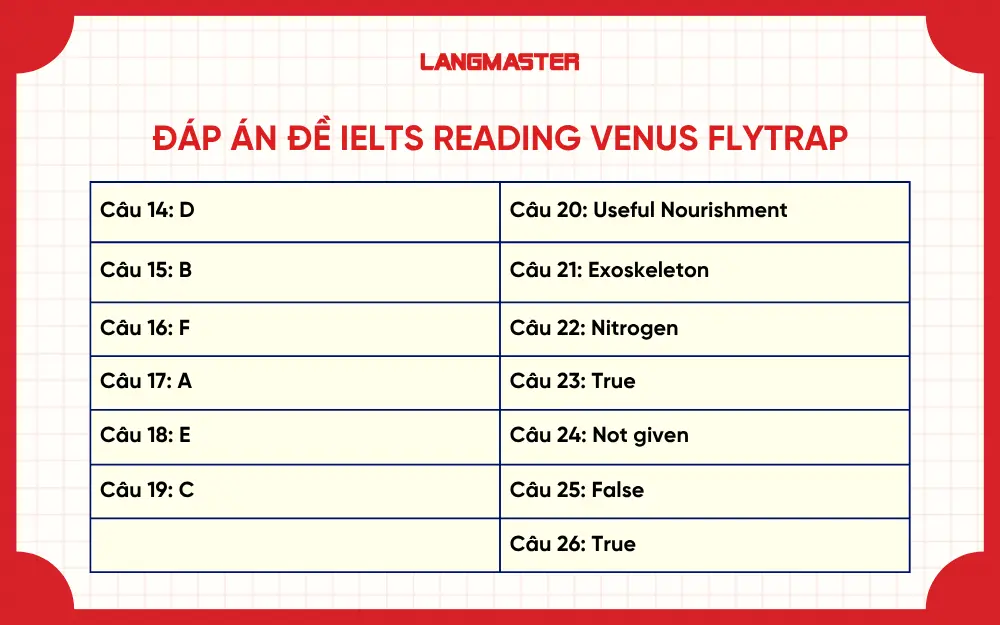
|
Câu 14: D |
Câu 20: Useful Nourishment |
|
Câu 15: B |
Câu 21: Exoskeleton |
|
Câu 16: F |
Câu 22: Nitrogen |
|
Câu 17: A |
Câu 23: True |
|
Câu 18: E |
Câu 24: Not given |
|
Câu 19: C |
Câu 25: False |
|
Câu 26: True |
Giải thích chi tiết:
Question 14 – Answer: D
Đoạn D mô tả toàn bộ quá trình ăn của Flytrap: đóng bẫy tạm thời → nếu con mồi đủ lớn thì miệng bẫy kín lại thành airtight compress → bắt đầu tiết dịch tiêu hóa trong 5–12 ngày → dịch tiêu hóa hòa tan mô mềm, tiêu diệt vi khuẩn, enzyme phân giải → khi hấp thụ xong thì bẫy mở ra và exoskeleton bị thổi bay.
Thông tin trong bài: “If the creature is large enough, however, the plant’s flaps will eventually meet to form an airtight compress, and at this point, the digestive process begins. … For somewhere between five and twelve days, the trap secretes acidic digestive juices … Once the plant has reabsorbed the digestive fluid … the trap reopens and the exoskeleton blows away in the wind.”
→ Đây rõ ràng là mô tả toàn bộ quá trình ăn, nên chọn D.
Question 15 – Answer: B
Đoạn B giải thích nguồn gốc tên “Venus” so sánh hành vi của cây (lure and devouring insects) với hình tượng phụ nữ quyến rũ trong xã hội cổ (seductresses) — tức là so sánh hành vi loài người (hình tượng phụ nữ) với hành vi cây.
Thông tin trong bài: “… botanists are believed to have seen a parallel between the behaviour of the plant in luring and devouring insects and the imagined behaviour of women in luring and ‘trapping’ witless men.”
→ Vì đây là so sánh giữa hành vi con người và hành vi cây, nên là đoạn B.
Question 16 – Answer: F
Đoạn F nói về tình trạng hoang dã và mối đe dọa, rồi nêu: “Punitive measures have been introduced to prevent people from doing this.” — tức là các biện pháp xử phạt được ban hành để bảo tồn (ngăn người ta lấy cây khỏi môi trường tự nhiên).
Thông tin trong bài: “The draining and destruction of natural wetlands … as well as people removing the plants from their natural habitat. Punitive measures have been introduced to prevent people from doing this.”
→ Vì đây là chỉ rõ biện pháp bảo tồn (punitive measures), nên chọn F
Question 17 – Answer: A
Đoạn A mở đầu bằng ví dụ văn hoá: từ indigenous myths đến tiểu thuyết Day of the Triffids của John Wyndham và vở nhạc kịch Little Shop of Horrors — tất cả là các miêu tả văn hoá/ nghệ thuật về cây ăn thịt.
Thông tin trong bàI: “From indigenous myths to John Wyndham’s Day of the Triffids and the off-Broadway musical Little Shop of Horrors, the idea of cerebral, carnivorous flora has spooked audiences …”
→ Rõ ràng đoạn A nêu ví dụ văn hoá, nên chọn A
Question 18 – Answer: E
Đoạn E nêu hai đặc điểm nổi bật: (1) phân bố tự nhiên rất hạn chế (chỉ tìm thấy quanh Wilmington, North Carolina), và (2) khả năng chịu lửa (resilience to flame) — tác giả nói đây là một tính tò mò/đặc biệt: “One of the plant’s curious features is resilience to flame. It is speculated that the Flytrap evolved this …”
Giải thích: Câu hỏi hỏi về một đặc tính bất thường/đặc biệt trong thế giới thực vật — “resilience to flame” là tính chất khá bất thường cho thực vật (và đoạn E trình bày như một đặc điểm kỳ lạ/đáng chú ý), nên E là đáp án phù hợp.
Thông tin trong bài: “One of the plant’s curious features is resilience to flame. It is speculated that the Flytrap evolved this to endure through periodic blazes …”
>> Xem thêm: Giải đề IELTS Reading: How deserts are formed [Full answers]
Question 19 – Answer: C
Đoạn C mô tả cơ chế kích hoạt bẫy: trigger hairs, yêu cầu chạm hai lần trong 20 giây hoặc một lần nhanh liên tiếp — rồi nói cây không có hệ thần kinh và “researchers can only hypothesise as to how the rapid shutting movement works.” → nghĩa là cơ chế đóng nhanh của bẫy chưa được hiểu rõ.
Thông tin trong bài: “The plant has no nervous system, and researchers can only hypothesise as to how the rapid shutting movement works.”
→ Vì đây là nhắc tới khía cạnh sinh học chưa hiểu rõ, nên chọn C
Question 20 – Answer: Useful Nourishment
Trong đoạn D có câu: “this mechanism allows miniscule insects to escape, as they will not be a source of useful nourishment for the plant.” Cụm này khớp chính xác với chỗ trống về lý do vì sao bẫy mở cho con côn trùng quá nhỏ
Question 21 – Answer: exoskeleton
Đoạn D kết: “the trap reopens and the exoskeleton blows away in the wind.” Sau khi cây tiêu hoá phần mềm, chỉ còn lại phần vỏ ngoài (exoskeleton).
Question 22 – Answer: nitrogen
Đoạn E nêu: “these environments are so depleted in nitrogen, they asphyxiate other flora, but the Flytrap overcomes this nutritional poverty by sourcing protein from its insect prey.” → thiếu nitrogen là nguyên nhân nhiều cây không sống được ở đầm lầy.
Question 23 – Answer: True
Đoạn E: “One of the plant’s curious features is resilience to flame. It is speculated that the Flytrap evolved this to endure through periodic blazes …” → trực tiếp nói cây có khả năng chịu lửa. → TRUE.
>> Xem thêm: Giải đề IELTS Reading Left or Right [FULL ANSWER]
Question 24 – Answer: Not given
Đoạn F nói “some prominent conservationists have suggested the plant be given the status of ‘vulnerable’.”
Passage nêu conservationists (một số nhà bảo tồn) chứ không nói many botanists hay toàn bộ cộng đồng các nhà thực vật học mong muốn điều này. Không có thông tin nào nói rằng nhiều botanists muốn như vậy. Vì vậy không có đủ thông tin → NOT GIVEN
Question 25 – Answer: False
Passage: “In the last survey, only 35,800 Flytraps were found remaining in the wild, and some prominent conservationists have suggested … Since this research is considerably dated, having taken place in 1992, the present number is considerably lower.”
Bản văn nói 35,800 là con số khảo sát trước đây (1992) và hiện tại con số còn thấp hơn. Mệnh đề bảo “now survive = bây giờ còn 35,800” mâu thuẫn với đoạn văn → FALSE
Question 13 – Answer: True
Đoạn F nêu nguyên nhân suy giảm: “The draining and destruction of natural wetlands where the Flytrap lives is considered to be the biggest threat to its existence, as well as people removing the plants from their natural habitat.” → việc con người làm cạn/huỷ môi trường sống và lấy cây ra là nguyên nhân chính. → TRUE.
>> Xem thêm:
>> Xem thêm: Thời gian làm Reading IELTS: Chiến lược phân bổ và mẹo làm bài hiệu quả
Để đạt được band điểm IELTS cao người học cần một lộ trình luyện thi rõ ràng, môi trường giao tiếp thực tế và sự hướng dẫn từ giảng viên có chuyên môn cao. Trong số nhiều lựa chọn hiện nay, Langmaster được đánh giá là trung tâm luyện thi IELTS online uy tín và tốt nhất dành cho người mất gốc cũng như người mới bắt đầu.
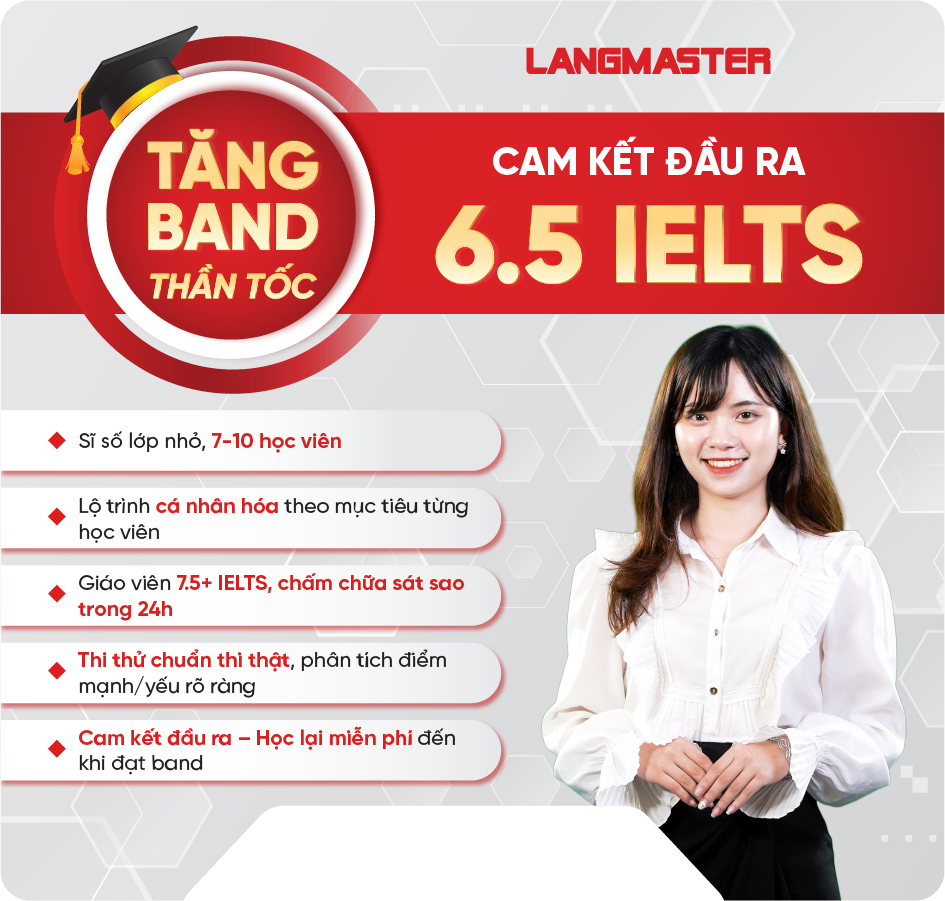
Khóa học IELTS Online tại Langmaster được thiết kế dựa trên giáo trình chuẩn đề thi thật, kết hợp học cá nhân hóa và phản hồi 1-1 từ giảng viên 7.5+ IELTS, giúp học viên phát triển toàn diện cả 4 kỹ năng: Listening, Speaking, Reading và Writing.

Ưu điểm nổi bật của khóa học IELTS Online Langmaster:
Nếu bạn đang tìm kiếm khóa học IELTS online tốt nhất, phù hợp cho cả người mới bắt đầu lẫn người mất gốc, Langmaster chính là lựa chọn đáng tin cậy để bứt phá band điểm IELTS mơ ước.
Hãy đăng ký khóa IELTS online tại Langmaster ngay hôm nay để nhận được buổi HỌC THỬ MIỄN PHÍ trước khi đăng ký.
KẾT LUẬN: Như vậy, chúng ta đã vừa cùng nhau phân tích và giải chi tiết đề IELTS Reading chủ đề Venus Flytrap. Bài viết đã làm rõ các kỹ năng cần thiết để tìm thông tin, nhận biết từ khóa và áp dụng chiến lược đọc hiểu hiệu quả. Hy vọng hướng dẫn này sẽ giúp bạn tự tin hơn khi làm bài và cải thiện điểm số Reading IELTS. Chúc bạn học tập hiệu quả và đạt kết quả cao trong kỳ thi IELTS sắp tới!


Các dạng bài phổ biến và tiêu chí chấm điểm IELTS Reading chi tiết nhất: Multiple Choice, Matching Information, Matching Headings,... và hướng dẫn chiến lược làm bài hiệu quả
Những sai lầm khi luyện IELTS Reading bao gồm: dịch từng từ, đọc hết cả bài, không đọc câu hỏi trước, không quản lý thời gian, không nắm vững kỹ năng paraphrase, viết sai chính tả
![Giải đề IELTS Reading: A brief history of humans and food [full answers]](https://langmaster.edu.vn/storage/images/2025/09/20/a-brief-history-of-humans-and-food-ielts-reading-answers.webp)
Giải đề thi IELTS Reading “A brief history of humans and food” kèm full đề thi thật, câu hỏi, đáp án, giải thích chi tiết, và từ vựng cần lưu ý khi làm bài.
Tổng hợp IELTS Reading tips hay nhất giúp bạn đọc nhanh, nắm ý chính và xử lý thông tin chính xác, tự tin đạt điểm cao trong kỳ thi IELTS.
![Giải đề IELTS Reading: The importance of law [Full answers]](https://langmaster.edu.vn/storage/images/2025/09/22/55.webp)
Giải đề IELTS Reading “The importance of law” kèm đáp án chi tiết, từ vựng quan trọng và bí quyết luyện thi hiệu quả để nâng cao band điểm.



Hơn 16 năm kinh nghiệm, đào tạo thành công 800.000+ học viên
Phương pháp giảng dạy hiện đại, học viên tiến bộ rõ rệt
Lộ trình học chuẩn quốc tế, phù hợp với nhu cầu thực tiễn
Giáo viên đạt chuẩn Quốc tế với chất lượng top đầu thị trường, giàu kinh nghiệm
Học online linh hoạt, cam kết đầu ra bằng văn bản